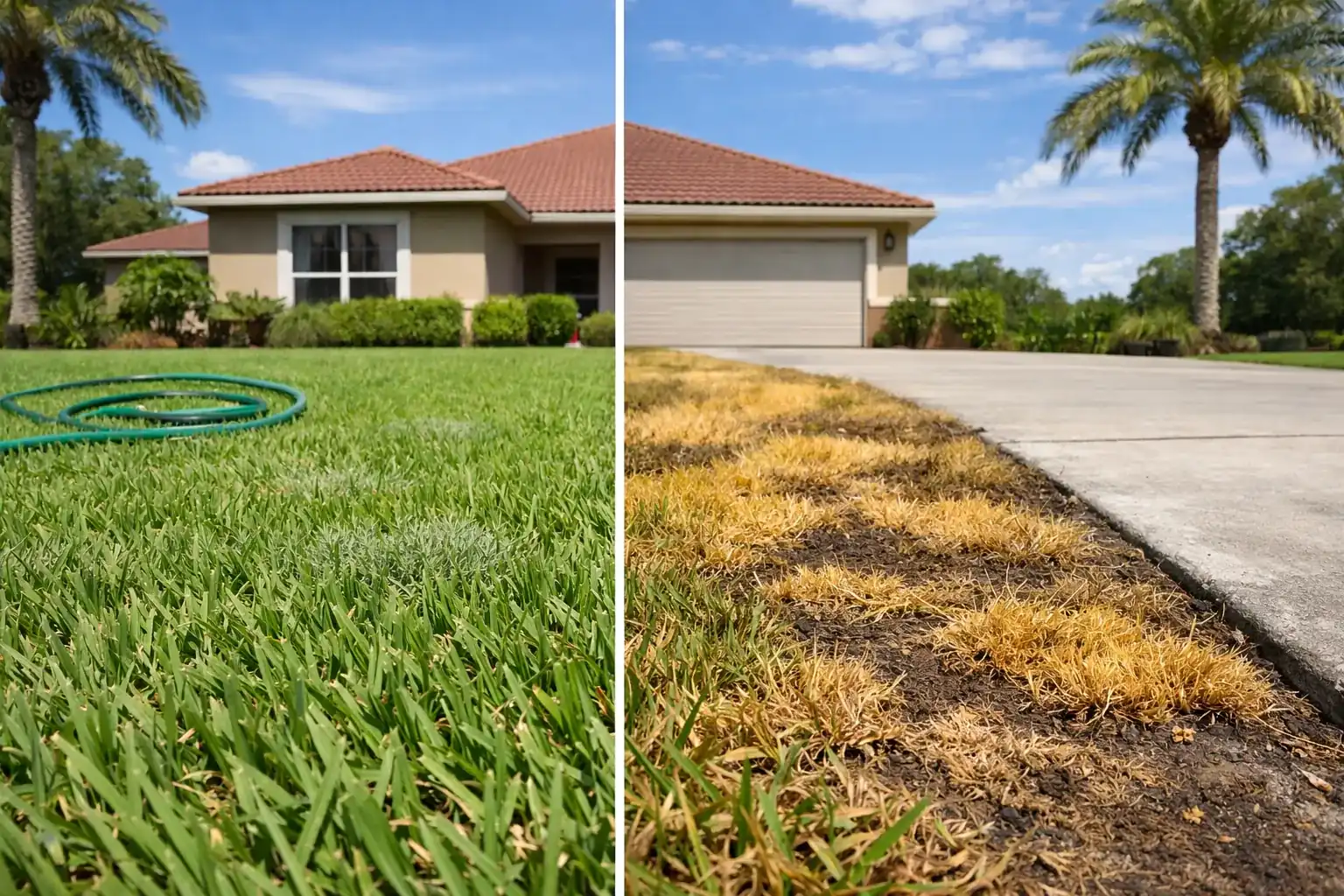
Chinch Bug Damage vs. Drought Stress: How to Tell What’s Really Killing Your Florida Lawn
Chinch bug damage vs. drought stress in Florida is one of the most common misdiagnoses I deal with all summer long — and getting it wrong can cost you weeks of wasted effort and a dead lawn.
I’m Austin Halsey, owner of Alpha Landscaping LLC in Davenport, Florida. I’ve been maintaining lawns across Polk and Osceola Counties since 2020. And every summer, without fail, I get calls from homeowners who have been dumping extra water on brown patches for two or three weeks straight — only to watch the damage keep spreading.
Nine times out of ten, it’s not drought. It’s chinch bugs.
I’ve created a guide that tells you exactly how to tell the difference, what to look for, and what to do once you know which one you’re dealing with.
Why This Mistake Is So Easy to Make
Here’s the thing — both problems look almost identical at first glance.
You walk outside and see yellow patches in the lawn. The grass looks dry, stressed, maybe a little brown at the tips. Your brain says, “It’s hot. The lawn needs water.” You run the sprinklers for an extra day or two and wait.
With drought stress, the lawn responds. It greens back up.
With chinch bugs, it doesn’t. The patches stay yellow. Then they turn brown. Then they spread outward.
Because chinch bugs proliferate during hot and dry times of the year, many people confuse the issue with drought and respond with heavy watering. The problem is you cannot water your way out of a chinch bug infestation — in fact, overwatering can make things worse.
That’s the trap. The more you water a chinch bug problem thinking it’s drought, the more you stress the roots and the worse the infestation gets.
So let’s stop guessing and start diagnosing.
What Drought Stress Actually Looks Like
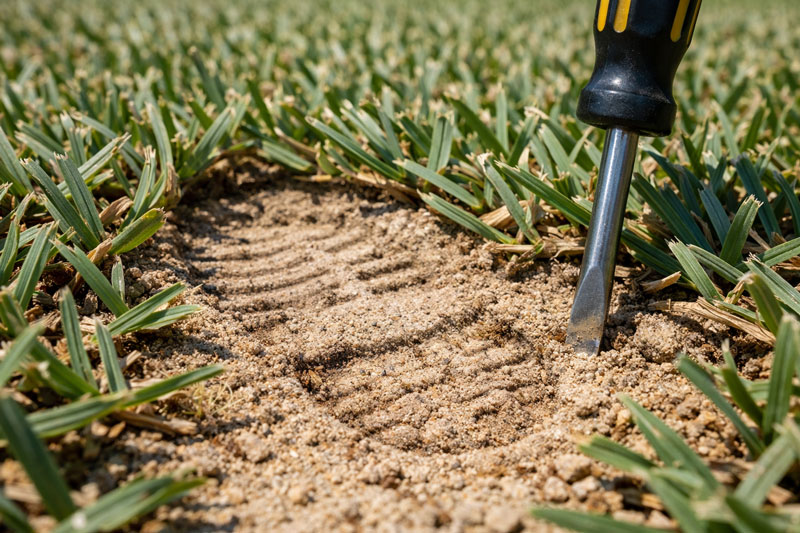
Drought stress in St. Augustine grass shows up in a predictable way. The grass is telling you it needs water — it just uses its own signals to do it.
Signs your lawn has drought stress:
- Blades fold or curl inward — St. Augustine folds lengthwise when it’s thirsty
- Color turns dull, grayish-green — not yellow, not brown, just flat and lifeless
- Footprints stay visible — walk across the lawn and look back. If the blades don’t spring back, the lawn needs water
- Patches appear throughout the yard — not just in one sunny zone
- Soil feels dry an inch or two down — stick a screwdriver in the ground. If it’s hard to push in, you have a moisture problem
The key thing about drought stress: it responds to water. Give a drought-stressed lawn a good deep soak early in the morning and check back in 24 to 48 hours. If the color comes back and the blades unfold, you had a watering issue. Problem solved.
If the patches look the same or worse after watering — keep reading.
What Chinch Bug Damage Looks Like
Chinch bugs are tiny. The southern chinch bug (Blissus insularis) is the primary culprit in Florida, measuring only about one-fifth of an inch long when fully grown. Adult chinch bugs have distinctive black bodies with white wings folded across their backs, while young nymphs appear reddish-orange with a white band across their abdomen.
You’re almost never going to spot them just by looking at the grass from standing height. What you see is their damage — and it has very specific patterns.
Signs your lawn has chinch bugs:
- Yellow patches that start near concrete — driveways, sidewalks, curbs. Chinch bugs love heat, and pavement radiates heat into the turf
- Patches are irregular, not circular — disease tends to appear in round circles. Chinch bug damage spreads outward in irregular, jagged patterns
- Damage expands week after week — drought stress stays roughly in the same spot. Chinch bug damage keeps growing as the insects move outward to find fresh grass
- Grass doesn’t recover after watering — this is the biggest tell. If you’ve given the lawn proper water and the patches are still spreading, stop watering and start looking for bugs
- Grass blades crumble or feel brittle — as chinch bugs feed, they inject a toxin into the grass that causes it to turn yellow and eventually die. Damage appears much faster on grass that is already under heat or drought stress.
According to UF/IFAS Gardening Solutions, St. Augustine grass heavily infested with southern chinch bugs will initially turn yellow but rapidly progress to dark brown. The grass will die if the pest is not controlled. Chinch bug infestations can appear at any time, but are most common in turf that has been stressed.
Side-by-Side Comparison Table
Here’s a quick cheat sheet I share with my customers when they call with a brown patch question:
| Clue | Drought Stress | Chinch Bug Damage |
|---|---|---|
| Where patches appear | Scattered across yard | Near concrete, sunny edges |
| Patch shape | Uneven but general | Irregular, spreading outward |
| Grass color | Grayish-green, dull | Yellow turning brown |
| Responds to watering | Yes — greens up in 24–48 hours | No — damage continues or worsens |
| Grass blades | Fold or curl inward | Brittle, crumble when touched |
| Spread over time | Stays in same area | Expands week over week |
| Soil moisture | Dry below surface | May feel moist — water isn’t the issue |
| Time of year | Any dry stretch | Heaviest April through October |
The Coffee Can Float Test (Do This Before You Do Anything Else)
If you’re not sure which one you’re dealing with, this test settles it in about 10 minutes. I recommend it to every homeowner who calls me about a mystery brown patch.
What you need: A metal coffee can (the old-school kind), a can opener, and water.
How to do it:
- Use a can opener to remove both ends of the can — top and bottom
- Push the open can about 3 inches into the soil at the edge of the damaged area, right where green grass meets yellow or brown grass. That’s the active feeding zone
- Fill the can three-quarters full with water
- Wait 10 minutes, then gently stir the water
- Look closely at the surface
According to UF/IFAS, chinch bugs will float to the water surface within 5 minutes. They’re tiny but visible — look for small black insects with white wing markings floating at the top.
If nothing floats, run the test in two or three other spots along the damaged area before ruling out chinch bugs entirely.
No bugs? Your problem is likely drought stress, irrigation, or possibly a fungal disease. Bugs present? Time to treat.
A Second Way to Check: Part the Grass by Hand
Get a handheld vacuum and vacuum about one square foot of grass in an area that includes both dead and living grass — this is likely a zone of active feeding. Dump the debris from the vacuum onto white paper or a light-colored tray and look for chinch bugs.
No vacuum? You can also just get down on your hands and knees at the edge of a damaged patch. Part the grass blades right down to the soil. Chinch bugs live in the thatch — they don’t hang out on top of the blades where you can see them easily. Look slowly and carefully. Bring your phone camera and zoom in if needed.
Adult chinch bugs are black with white wing markings. Nymphs are bright orange-red with a white stripe across their back. Both are very small — roughly the size of the tip of a pen.
What to Do If You Have Drought Stress
This one’s straightforward. Fix your watering habits.
- Water twice a week, not every day. Deep and infrequent is the goal. Short daily watering keeps roots shallow and the lawn weak
- Water early in the morning — before 10 AM. Less evaporation, more absorption, lower disease risk
- 45 to 60 minutes per zone depending on your sprinkler heads and soil
- Check your sprinkler heads — clogged or broken heads create dry spots that look like drought damage but are really irrigation gaps
Give the lawn one or two proper deep watering sessions and it should respond within 48 hours. If it doesn’t — go back and do the coffee can test.
For a full watering schedule and summer lawn routine, check out my St. Augustine grass summer care guide — it covers everything.
What to Do If You Have Chinch Bugs
Act fast. These insects move quickly and the longer you wait, the more grass you lose.
Step 1: Confirm the infestation with the float test. Don’t treat for chinch bugs until you’ve confirmed they’re actually there. Unnecessary insecticide applications are a waste of money and harm beneficial insects.
Step 2: Choose the right insecticide. Insecticides labeled for chinch bugs include bifenthrin and imidacloprid — bifenthrin is one of the most commonly recommended active ingredients for homeowner use, available in both granular and liquid formulations. Always read the label and follow directions exactly.
Step 3: Treat the right area. Don’t just spray the dead patches — those bugs have already moved on. Treat the border zone between healthy and damaged grass. That’s where the active feeding is happening. Then treat a buffer around that zone.
Step 4: Water in the treatment. After applying a granular insecticide, water the lawn lightly to activate it and move it into the thatch where the bugs live.
Step 5: Be ready to retreat. In areas where chinch bugs are a serious problem, a single thorough insecticide treatment may offer only temporary control — repeat applications may be required. Some populations have become resistant to synthetic pyrethroid insecticides.
Step 6: Help the lawn recover. Once the bugs are controlled, the damaged areas need support to come back. Good watering, the right fertilizer at the right time, and proper mowing height all matter here. My guide on the best fertilizer for St. Augustine grass walks through exactly what to use and when.
Why Chinch Bugs Hit Stressed Lawns Harder
This is something I want every Florida homeowner to understand.
Chinch bugs don’t discriminate equally across all lawns. They target stressed turf first. Chinch bugs are most common on lush, heavily fertilized grass and on grass with a heavy thatch layer. Damage is often more severe in areas of the lawn exposed to more heat stress — such as near roadways, driveways, or sidewalks.
A lawn that’s mowed too low, watered improperly, or sitting on a thick thatch layer is a far easier target than a healthy, well-maintained one. That’s why good habits aren’t just about looks — they’re about pest resistance.
The healthier your lawn is day-to-day, the harder it is for chinch bugs to get a foothold. Check out easy fixes for common lawn problems in Central Florida for a broader look at what keeps Florida lawns resilient year-round.
Could It Be Something Else? (Gray Leaf Spot)
If you’ve ruled out both drought stress and chinch bugs but still have a problem — it’s worth considering gray leaf spot, a fungal disease that can look similar in certain conditions.
Gray leaf spot identification involves looking for parts of the lawn thinning out. Closely inspect blades of grass in the affected areas for grayish spots with dark brown edges. Large areas of the lawn may have a scorched appearance, similar to extreme drought stress.
Unlike chinch bugs, gray leaf spot tends to show up after heavy rain and humidity — the kind of wet summer afternoons we get regularly in Polk and Osceola Counties. If you see actual spots on the grass blades themselves (not just yellow or brown color), you may be dealing with a fungal issue rather than insects or irrigation.
When in doubt, pull a handful of affected blades and look at them closely — or send a sample to your local UF/IFAS Extension office for a professional diagnosis. It’s fast, affordable, and tells you exactly what you’re fighting.
Real Story: Three Weeks of Watering the Wrong Problem
Last summer a homeowner in Kissimmee called me frustrated. He’d been battling a brown patch near his driveway for three weeks. He’d watered it, given it fertilizer, even aerated near the edge. Nothing worked. The patch had gone from the size of a trash can lid to about 8 feet wide.
I drove over and did the coffee can test in under 10 minutes. Chinch bugs — a lot of them.
He had been treating drought stress that wasn’t there. The whole time, bugs were feeding and moving outward. Every week he waited added more damaged sod to replace.
We treated the active zone with bifenthrin granules, watered it in, and scheduled a follow-up treatment two weeks later. The infestation cleared up. But he lost about 60 square feet of turf that had to be patched.
The lesson isn’t complicated: diagnose first, treat second. The coffee can test takes 10 minutes and it would have saved him a month of frustration.
When to Call a Pro
Some chinch bug infestations are manageable on your own. But there are situations where you need professional eyes.
Call us or another licensed lawn care pro if:
- The damaged area is larger than 100 square feet and still spreading
- You’ve treated twice and the damage hasn’t slowed
- You’re not confident in what you’re looking at
- You want a full lawn assessment to catch problems before they get expensive
We serve homeowners and property managers across Davenport, Four Corners, Clermont, and all of Polk and Osceola Counties. Our residential lawn maintenance service keeps a trained set of eyes on your yard every week — which is the best way to catch chinch bug damage early, before it spreads.
Get a free quote or contact us and we’ll come take a look.
FAQs: Chinch Bug Damage vs. Drought Stress in Florida
How do I know for sure if my lawn has chinch bugs or drought stress?
Do the coffee can float test. Push an open metal can 3 inches into the soil at the edge of the damaged area, fill it with water, and wait 10 minutes. If chinch bugs are present, they float to the surface. No bugs — it’s likely drought stress or an irrigation issue.
Can I water my way out of a chinch bug problem?
No. Extra watering will not fix a chinch bug infestation. It may actually worsen it by further stressing the root system. Confirm the problem with the float test, then treat with an appropriate insecticide.
Where do chinch bugs typically show up first on a Florida lawn?
Injury typically occurs first in grass that’s water-stressed or in full sun. Look near driveways, sidewalks, and street curbs first — these areas absorb and radiate the most heat.
What do chinch bugs look like?
Adults are tiny — about the size of a pen tip. They have black bodies with white wings marked with a dark pattern. Nymphs are bright orange-red with a white stripe. You’ll need to part the grass down to the soil to spot them, and a magnifying glass helps.
Will drought-stressed grass recover on its own?
Yes, with corrected watering. Water deeply twice a week in the early morning. Most drought-stressed St. Augustine grass shows visible improvement within 24 to 48 hours of a proper deep soak.
When are chinch bugs most active in Central Florida?
According to UF/IFAS, southern chinch bug activity occurs from March through November in north-central Florida and is year-round in southern Florida. Peak damage in Polk and Osceola Counties typically falls in the hottest months — June through September.
Does a healthy lawn resist chinch bugs better?
Yes. Proper mowing height, deep watering, correct fertilization, and thatch control all make your lawn harder for chinch bugs to damage. A stressed lawn is always a more vulnerable one.
What insecticide works best for chinch bugs in Florida?
Bifenthrin and imidacloprid are both commonly used and effective. Apply according to the label. Be aware that some Florida chinch bug populations have developed resistance to certain pyrethroid insecticides — if one product fails after two applications, switch to a different active ingredient or call a pro.
The Bottom Line
Chinch bug damage vs. drought stress in Florida comes down to one simple test and a few key observations. Look at where the patches are, watch whether they spread over time, and check whether watering helps or doesn’t. When in doubt — do the coffee can float test.
Get it right early and you save your lawn. Get it wrong and you’re replacing sod.
If you’re in the Davenport, Clermont, Kissimmee, or the Four Corners area and you’re not sure what you’re looking at — give us a call. Alpha Landscaping LLC has been working these lawns since 2020 and we’ve seen every version of this problem. We’ll tell you exactly what’s going on and what it takes to fix it.
Related Reading: