St. Augustine Grass Summer Care Guide: What Every Florida Homeowner Needs to Know
A good St. Augustine grass summer care guide can be the difference between a yard that looks sharp all season and one that turns brown, patchy, and embarrassing by July.
I’m Austin Halsey, founder of Alpha Landscaping LLC right here in Davenport, Florida. Learn a bit about me and how we got started — my crew maintains lawns across Polk and Osceola Counties every single week.
The truth? Most of the time it’s not one big problem. It’s two or three small habits that are stacking up against you.
This guide lays out exactly what works — and what doesn’t — based on real yards, real summers, and years of experience in Central Florida’s heat and humidity.
Why St. Augustine Grass Struggles in Florida Summers
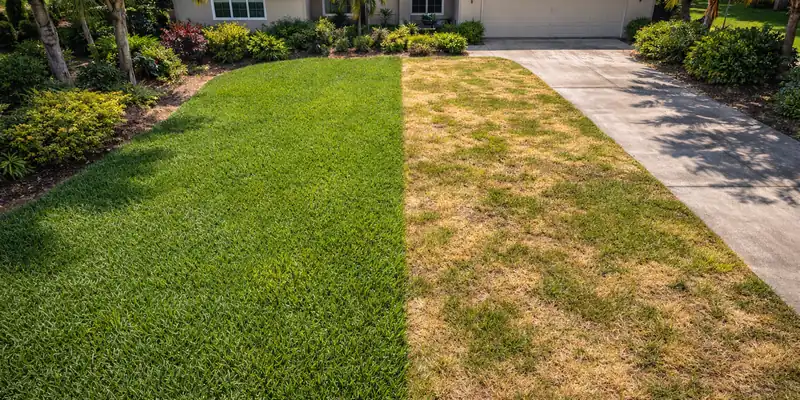
St. Augustine grass is actually a strong, heat-tolerant turf. It’s the most widely planted lawn grass in Florida, according to the University of Florida IFAS Extension. That’s not a coincidence. It handles our sandy soil, our humidity, and our afternoon rainstorms better than most grass types.
But summer pushes it hard.
We’re talking about 90-degree temps, a blazing sun with almost no cloud cover in the morning, and afternoon storms that dump water fast — then stop. That cycle of heat and inconsistent moisture is tough on roots.
When homeowners tell me “my lawn looked fine in May and now it’s a mess,” here’s what I usually find:
- Mowing too low (scalping the turf)
- Watering at the wrong time or in short, frequent bursts
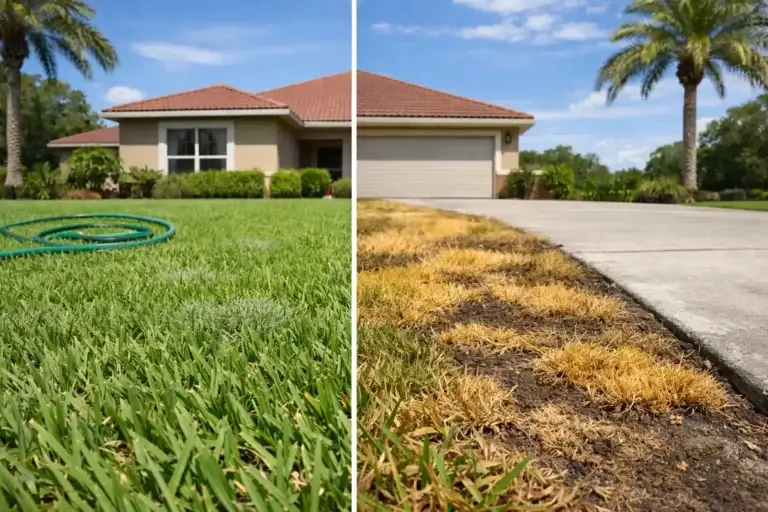
- Chinch bug damage they mistook for drought stress
- Fertilizing at the wrong time or with the wrong product
- Thatch blocking water from reaching the roots
Let’s go through each one and fix it.
The Right Watering Schedule for St. Augustine Grass in Summer
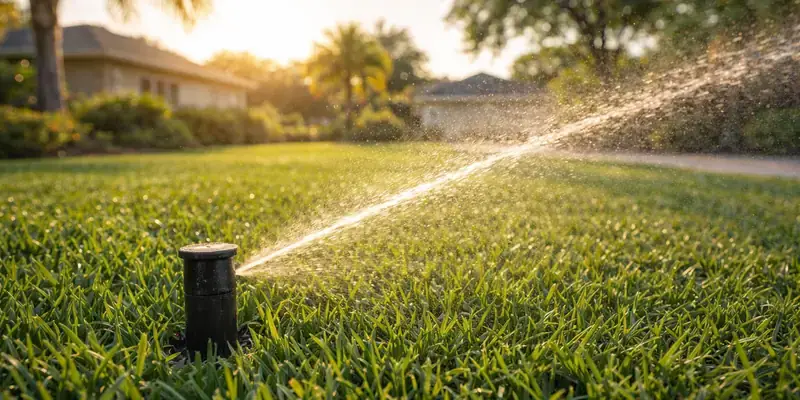
This is where I see the most mistakes, and it’s almost always the first thing I address when a customer calls with a brown lawn.
Most people water too often and not deep enough. That trains roots to stay shallow. Shallow roots cook in summer heat.
The goal is deep, infrequent watering that pushes roots down into cooler soil. Here’s what UF/IFAS recommends — and what I’ve confirmed works on hundreds of Central Florida yards:
Twice a week. Early morning. 45 to 60 minutes per zone.
According to the UF/IFAS turfgrass irrigation research, St. Augustine grass in Florida’s warm months needs roughly 5 to 5.7 inches of water per month during peak growing season. That’s a meaningful amount — and it needs to go in slowly and deeply, not in quick 15-minute bursts.
Your Summer Watering Schedule at a Glance
| Situation | Days Per Week | Minutes Per Zone | Best Time |
|---|---|---|---|
| Normal summer temps | 2 | 45 | Before 10 AM |
| Hot and dry stretch | 2 | 60 | Before 10 AM |
| Shaded areas | 2 | 30–35 | Before 10 AM |
| New sod (first 2 weeks) | Daily | 20–30 | Before 10 AM |
Why early morning matters:
- Less evaporation from the sun
- Grass blades dry off during the day, cutting disease risk
- Roots have time to absorb moisture before the afternoon heat kicks in
If you’re seeing gray-green color, folded blades, or footprints that stay visible after you walk across the lawn — your grass is thirsty. Water that day, then get back on a steady schedule.
On the flip side, if you notice mushrooms popping up or grass that looks waterlogged — you’re overdoing it. Overwatering leads to shallow roots, fungal disease, and root rot. Let the soil breathe.
The Right Mowing Height for Summer (Don’t Scalp Your Lawn)
I’ll say it straight: mowing too low is one of the fastest ways to destroy a St. Augustine lawn in summer.
UF/IFAS recommends keeping standard St. Augustine cultivars like Floratam between 3.5 and 4 inches year-round — and that recommendation becomes critical in the summer heat. (Source: UF/IFAS, St. Augustinegrass for Florida Lawns)
Taller grass does three important things:
- Shades the soil and roots from direct sun
- Holds moisture in the ground longer
- Crowds out weeds naturally
When you cut it short, you’re exposing the root system to heat stress, inviting weeds in, and forcing the grass to work twice as hard to recover. I’ve seen lawns take three to four weeks to bounce back from one bad scalping.
Summer Mowing Rules I Give Every Customer
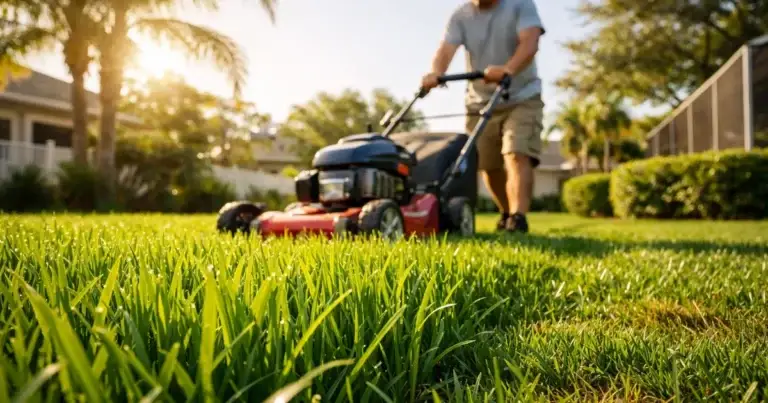
- Mow at 3.5 to 4 inches — always
- Never cut more than one-third of the blade at a time (this is called the one-third rule)
- Keep mower blades sharp — dull blades shred the grass and leave a brown cast on top
- Don’t mow wet grass — it clumps and spreads disease
- Bag clippings only if thatch is thick; otherwise leave them to feed the soil
Want the full breakdown by cultivar? I wrote a dedicated guide on the best mowing height for St. Augustine grass in Central Florida — it covers every variety and why height matters more than most people think.
Feeding Your Lawn: Summer Fertilization Done Right
St. Augustine grass is a heavy feeder during the growing season. But summer fertilization has some rules you need to follow — especially here in Polk and Osceola Counties.
First, the law. Florida has fertilizer blackout periods in many counties during summer months because of the risk of nitrogen runoff during heavy rain. Always check your county’s current rules before applying. Polk County follows Florida’s model fertilizer ordinance, which typically restricts nitrogen and phosphorus applications from June 1 through September 30. Check with your local UF/IFAS Extension office for the current rules.
Second, slow-release is king. A slow-release nitrogen fertilizer feeds steadily over time instead of dumping nutrients all at once. That reduces runoff risk and prevents the kind of rapid flush growth that makes your lawn need mowing every four days.
Third, iron is your secret weapon. If your lawn turns light green or yellowish in summer, the problem is often an iron deficiency — not a nitrogen shortage. A foliar iron treatment brings the color back fast without pushing a ton of new growth. According to UF/IFAS research, foliar iron sulfate or chelated iron solutions are both effective options.
For a full breakdown of what to feed your lawn and when, check out my guides on the best fertilizer for St. Augustine grass and when to fertilize St. Augustine grass in Florida.
Watch for Chinch Bugs — They’re the #1 Summer Pest
If there’s one bug I talk about more than any other in summer, it’s the southern chinch bug. See our full guide: chinch bug damage vs drought stress.
UF/IFAS calls it “the most important insect pest of St. Augustine grass in Florida.” (Source: UF/IFAS Ask IFAS) And 2024 was reportedly one of the worst years for chinch bug damage in the past decade, with professionals across the state struggling to get them under control.
These tiny bugs are barely 3/16 of an inch long. They live in your thatch layer and suck fluids from the grass’s stems and stolons. Their damage looks a lot like drought stress — yellow patches that spread outward from sunny, open areas near sidewalks and driveways.
The problem is that people water those patches thinking the lawn is thirsty. It’s not. The bugs keep feeding and the damage keeps spreading.
How to Tell if You Have Chinch Bugs
- Yellow to brown patches in full sun areas, especially near pavement
- Patches that grow wider each week even when you water
- Grass that crumbles when you rub the blades between your fingers
- Tiny black-and-white insects visible in the thatch if you look closely
Quick test: Cut both ends off an old coffee can. Push it 2 to 3 inches into the soil at the edge of a damaged patch. Fill it with water. If chinch bugs are present, they’ll float to the surface within a few minutes.
What to Do
- Apply a lawn-safe insecticide labeled for chinch bugs — treat the entire affected area plus a buffer zone around it
- Water in the treatment well
- Follow up with proper nutrition to help the grass recover
- Don’t ignore it — the damage spreads fast in heat
If you’re not sure what you’re dealing with, call a pro. I’ve seen homeowners spend months treating “drought stress” that turned out to be an insect infestation the whole time. If you’re in the Davenport, Four Corners, or Clermont areas, our team can take a look and give you a straight answer.
Control Thatch Before It Chokes Your Lawn
Thatch is the layer of old stems, roots, and organic debris that builds up just above the soil. A thin layer — under a quarter inch — is actually fine. It acts like insulation.
But when thatch builds up past half an inch, it starts blocking water, fertilizer, and oxygen from reaching the roots. Your lawn can look watered and fed and still struggle because none of it is getting through.
Signs of a thatch problem:
- The lawn feels spongy when you walk on it
- Water runs off instead of soaking in
- Brown patches appear after mowing even though the grass is watered
What to do:
- Raise your mowing height — low cuts push more material into the thatch layer
- Bag your clippings for a few weeks
- For heavy thatch over half an inch, a mechanical dethatching (power rake) may be needed
This is one of those jobs that makes a huge difference. Once the thatch is cleared, water and nutrients actually reach the root zone and the lawn responds almost immediately.
Add Mulch Around Beds and Borders
This one doesn’t always make the summer care lists, but I tell all my customers about it.
Mulching your garden beds and the edges of your lawn keeps the soil temperature down, holds moisture in, and stops weeds from pushing into your turf from the sides. It also just makes the whole yard look pulled together.
We do a lot of mulching and seasonal yard cleanup across Davenport and the surrounding areas, and the difference it makes in summer is real. Cooler soil around your lawn borders means less stress on the edges of your turf — and that’s where heat damage tends to show up first.
Don’t Forget Your Trees and Shrubs
Summer is also when tree limbs and shrub growth can get out of hand fast. Overgrown limbs that shade the lawn unevenly can create weak spots in the turf — some areas get too much shade, some get scorched.
Keeping your trees properly trimmed and your hedges and shrubs maintained lets the right amount of light reach the lawn without baking it.
I also wrote a full guide on the best time to trim trees in Davenport, FL if you want to know exactly when to schedule that work. And if you need a hand, check out our tree trimming services.
My Complete Summer Maintenance Routine
Here’s the routine I run for my own customers. Print it out. Stick it on the fridge. It works.
Every Week
- Mow at 3.5 to 4 inches
- Check soil moisture (stick a screwdriver 6 inches into the ground — if it goes in easy, you have moisture; if it’s hard, water)
- Scan for yellow patches or pest signs
Every 2 to 3 Weeks
- Edge the borders clean
- Trim low-hanging tree limbs shading the turf unevenly
- Check and clean sprinkler heads
Every 6 to 8 Weeks (check county blackout rules first)
- Apply slow-release fertilizer
- Add iron if color is fading to light green or yellow
Each Season
- Inspect thatch depth
- Check for low or uneven spots where water pools
- Review and adjust irrigation schedule
Real Story: Davenport Homeowner Turned It Around in Two Weeks
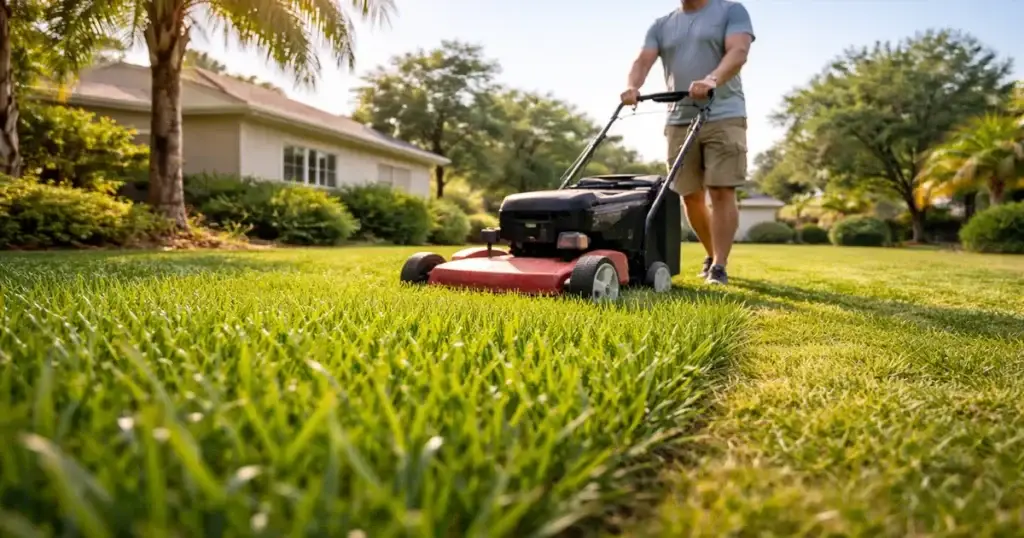
Last summer, a homeowner in Davenport called me convinced his lawn was dying. He’d been watering every single day — sometimes twice — and it kept getting worse. He thought more water was the answer.
When I walked the yard I spotted two things fast:
- He was mowing at 2.5 inches — way too low for Floratam
- His irrigation ran five short cycles a day instead of two long ones
The grass roots were shallow, heat-stressed, and probably had some chinch bug pressure on top of it all.
We made three changes:
- Raised the mower deck to 4 inches
- Cut irrigation to two deep morning sessions per week
- Applied iron to restore the color
Two weeks later, I drove by his place and the lawn looked completely different. Green, full, and thick. He texted me a photo.
That’s what this guide is built around. Small, correct habits beat big, expensive fixes every time.
FAQ: St. Augustine Grass Summer Care Guide
Why does my St. Augustine grass turn brown in summer even when I water it?
Brown patches in summer are often chinch bug damage, not drought. Both look similar. Use the coffee can float test to check for bugs, and look at where the patches appear — chinch bugs usually start near sunny concrete edges.
How often should I water St. Augustine grass in summer?
Twice a week, early morning, 45 to 60 minutes per zone. Deep and infrequent beats short and daily every time.
What’s the best mowing height for St. Augustine grass in the summer?
3.5 to 4 inches for standard cultivars like Floratam. Never go lower than that during summer heat.
Can I fertilize St. Augustine grass during summer?
Check your county’s fertilizer blackout rules first. Polk County typically restricts nitrogen applications from June 1 through September 30. If you’re in the window, use slow-release fertilizer only.
My lawn looks yellow-green in summer. What’s wrong?
Most likely an iron deficiency. A foliar iron treatment (iron sulfate or chelated iron) brings the color back within days without pushing excessive growth.
How do I check if I have chinch bugs?
Push a bottomless coffee can 2 to 3 inches into the soil at the edge of a damaged spot. Fill it with water. Chinch bugs float to the surface within a few minutes.
Should I bag my grass clippings in summer?
Only if your thatch layer is already thick. Light clippings break down and feed the soil. Heavy clippings from missed mowing sessions should be bagged.
What’s the best time of day to water a Florida lawn?
Early morning — before 10 AM. It gives roots time to absorb water before the heat peaks and reduces disease risk by letting the blades dry during the day.
Wrap Up: Your St. Augustine Grass Summer Care Guide in a Nutshell
A great-looking summer lawn comes down to four habits: mow high, water deep twice a week, feed smart, and watch for pests.
For a complete look at year-round care beyond just summer — including spring green-up, fall fertilization, HOA lawn rules, and when to call a pro — check out our Central Florida lawn maintenance guide.
If you feel like you’re doing everything right and still seeing problems, it might be time to get a second set of eyes on it. That’s what we’re here for.
We serve homeowners and property managers across Davenport, Four Corners, Clermont, Kissimmee, and all of Polk and Osceola Counties. Whether you need weekly residential lawn maintenance, commercial lawn care, or just a one-time assessment, we’re ready.
Get a free quote or contact us today. This St. Augustine grass summer care guide gives you the foundation — we’ll handle the rest if you need us.
Related Reading: